Evidence-aware personalization
PersonaGuard
From evidence
to action.
When should an AI system personalize? Review what the evidence supports, what needs testing, and where a personal profile should stop.
Short answers, every time?
You ask AI to explain a math problem.
You skipped long explanations a few times.
“I’ll only give you short answers from now on.”
Does skipping an explanation mean you never need one?
You may have been in a hurry. A few actions do not establish a lasting learning preference.
More watch time. Better for you?
Over the weekend, you watch several lighthearted videos.
You spend longer on lighthearted content.
“I’ll reduce serious content and recommend lighter videos.”
Is longer viewing enough to justify changing your feed?
Watch time is one metric. It does not show whether you are more satisfied or miss content you wanted to see.
The same routine, away from home?
A reminder assistant learns your usual rest time this week.
The reminders fit your current routine.
“I’ll keep this profile and use it when you travel, too.”
Does what works this week still work in a new setting?
Time zones, work, and daily life can change. A useful profile today may not stay valid later or elsewhere.
Research projectFrom Evidence to Action: Auditing Personalization Decisions in HCI Systems
01 / THE QUESTION
A better estimate. A justified action?
In the MER-PS data we analyse, participants watch videos and use a joystick to report how pleasant and activated they feel. Correcting a report’s timing may improve a measurement. Whether to personalize, collect more information, or retain a profile requires its own evidence.
The reference is built from other people’s reports; it is not a ground truth for this person’s feelings.
02 / THE METHOD
Make the decision boundary explicit.
Full method →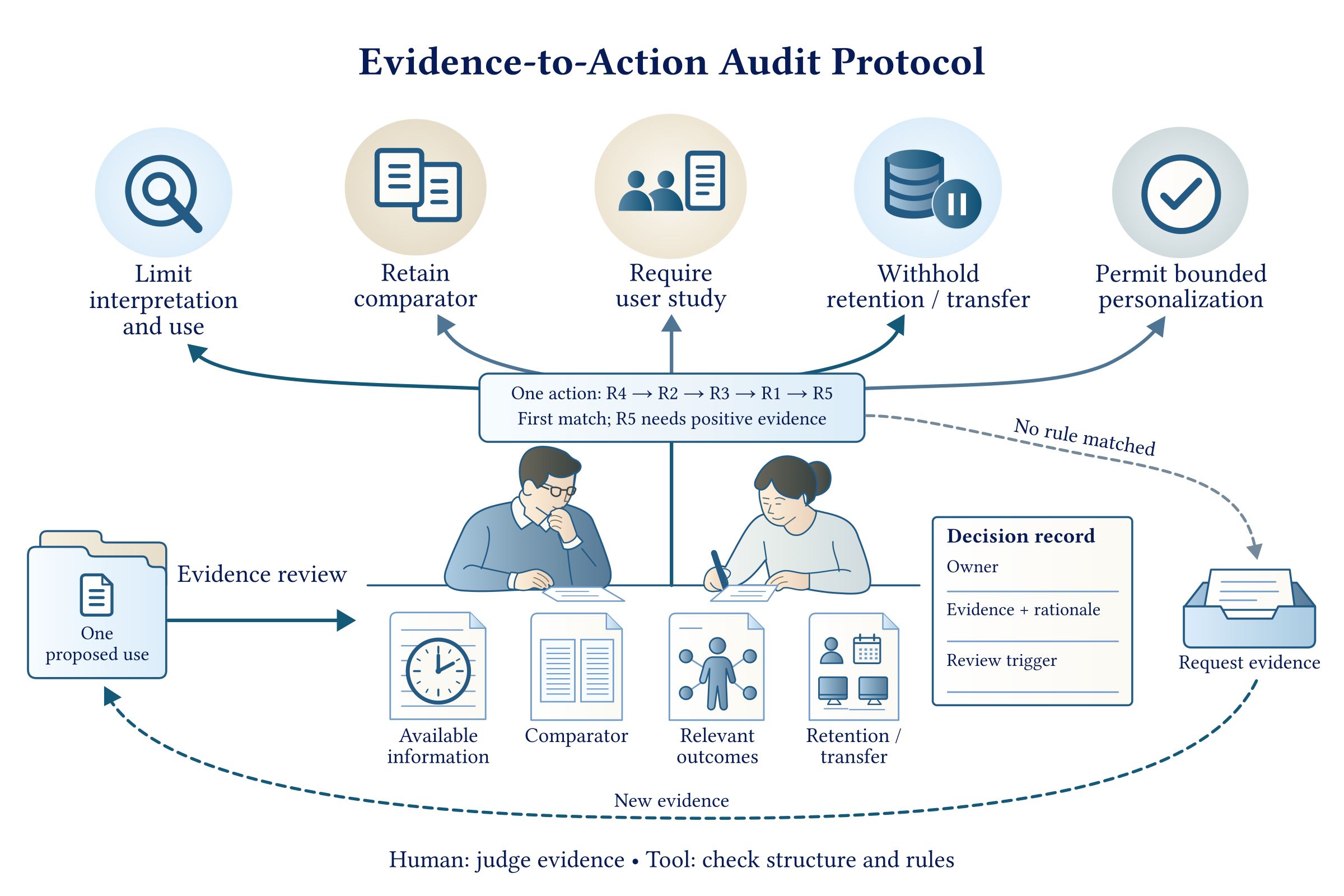
Specify the use
State the action, deployment stage, and the people and setting it will affect.
Match the evidence
Review scope, comparator benefit, user outcomes, and support for future reuse.
Record the next step
Apply five ordered rules. Keep the decision, its reason, and the conditions for review together.
03 / THE EVIDENCE
Inspect the checks. Read the boundaries.
All results →Executable checks test whether the rules behave as specified. Analyses of MER-PS examine what the evidence can support. These answer different questions.
MER-PS worked cases + author-coded external study records
Improvement is specific to a use.
Interpretation, additional sensing, personal correction, and long-term profile reuse receive separate reviews. Technical gains alone do not establish a benefit for people using the system.
Evaluation design →Limits and next studies →04 / TRY IT
Change the evidence. See the next step.
SIGNED CALIBRATION · ORIGINAL RECORD
A preview of the recorded case; open the demo to edit evidence.
Local browser demo
The same rules. Visible reasoning.
Start from a recorded case, change an evidence condition, and inspect which rule determines the result. Your inputs stay on your device.
- Replay original and hypothetical conditions
- Inspect rule priorities and reasons
- Download the result as JSON
05 / EXPLORE FURTHER
Reproduce and inspect.
GitHub
Explore the code, public rules, and study records.
REPRODUCE →Quickstart
Run repository checks and replay the included cases.
EVIDENCE →Research results
Inspect complete figures, comparisons, and review outcomes.
DATA ↗Data & provenance
Check data requirements, access conditions, and provenance.