Wearable IMU activity records
An End-to-End Wearable IMU System for Segment-Level Activity Recognition via Multi-Scale Arbitration and a Temporal Record Layer
A multi-scale wrist-IMU pipeline that converts continuous 100 Hz signals into timestamped activity records.
Problem and output
Window-level predictions do not directly provide reliable activity records. A long-session system must recover the activity class, event count, duration, and boundaries from continuous sensor streams.
6-channel wrist IMU stream
{activity, start, end}
The evaluated task covers five sports recorded from a 100 Hz wrist accelerometer and gyroscope. Background motion supports decoding but is not emitted as a workout record.
Method
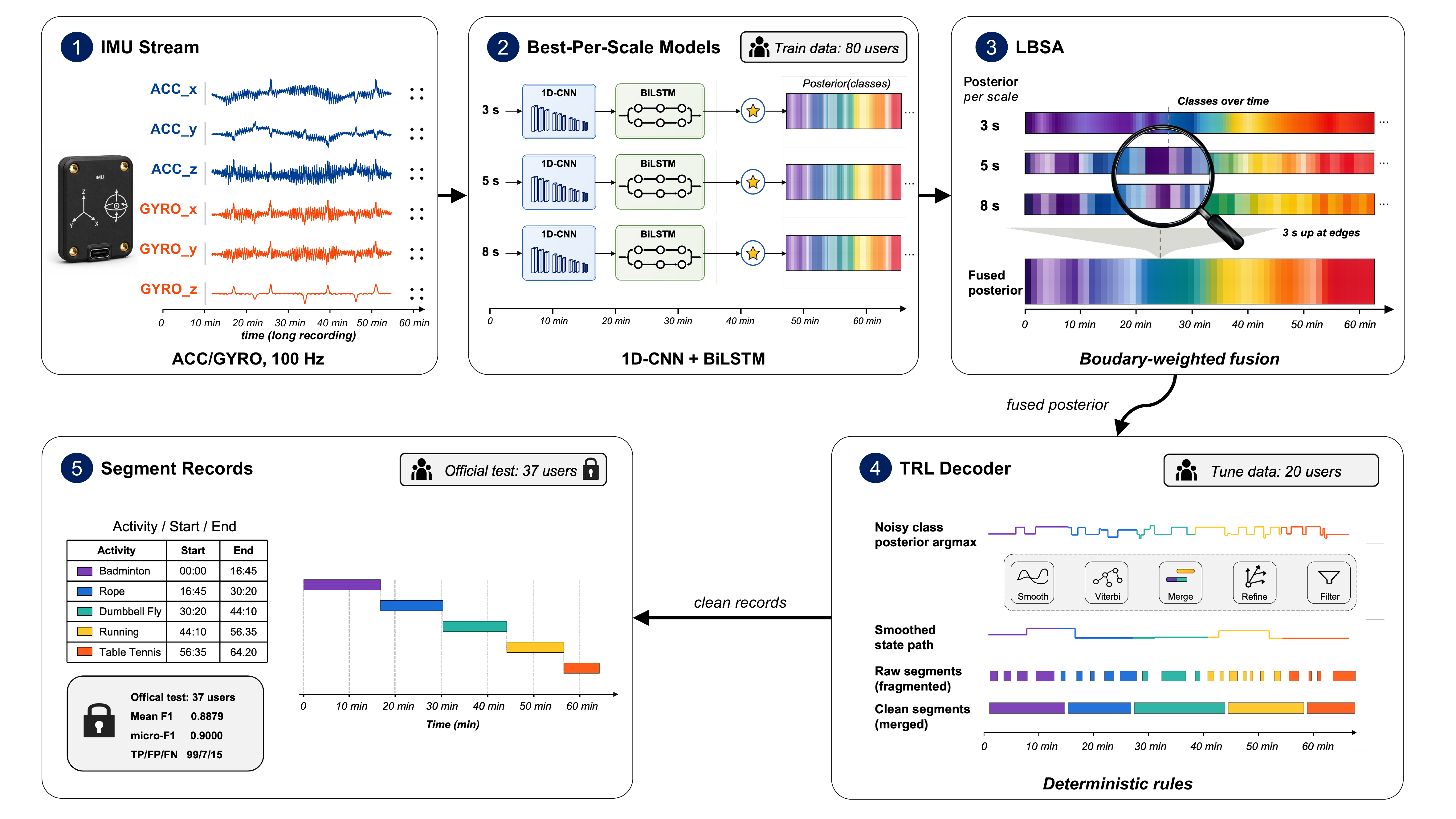
Multi-scale models
Scale-specific CNN–BiLSTMs analyze 3-, 5-, and 8-second views.
Boundary-aware fusion
LBSA favors short evidence near transitions and longer context in stable regions.
Record construction
TRL smooths, decodes, merges, refines, and filters the fused timeline.
Evidence
The operating point was frozen before evaluation on the independent 37-recording external test.
Evaluated scope
Five activities under the studied device, wrist placement, and long-session protocol.
New devices, placements, users, activities, and deployment conditions require new validation.
See the pipeline run
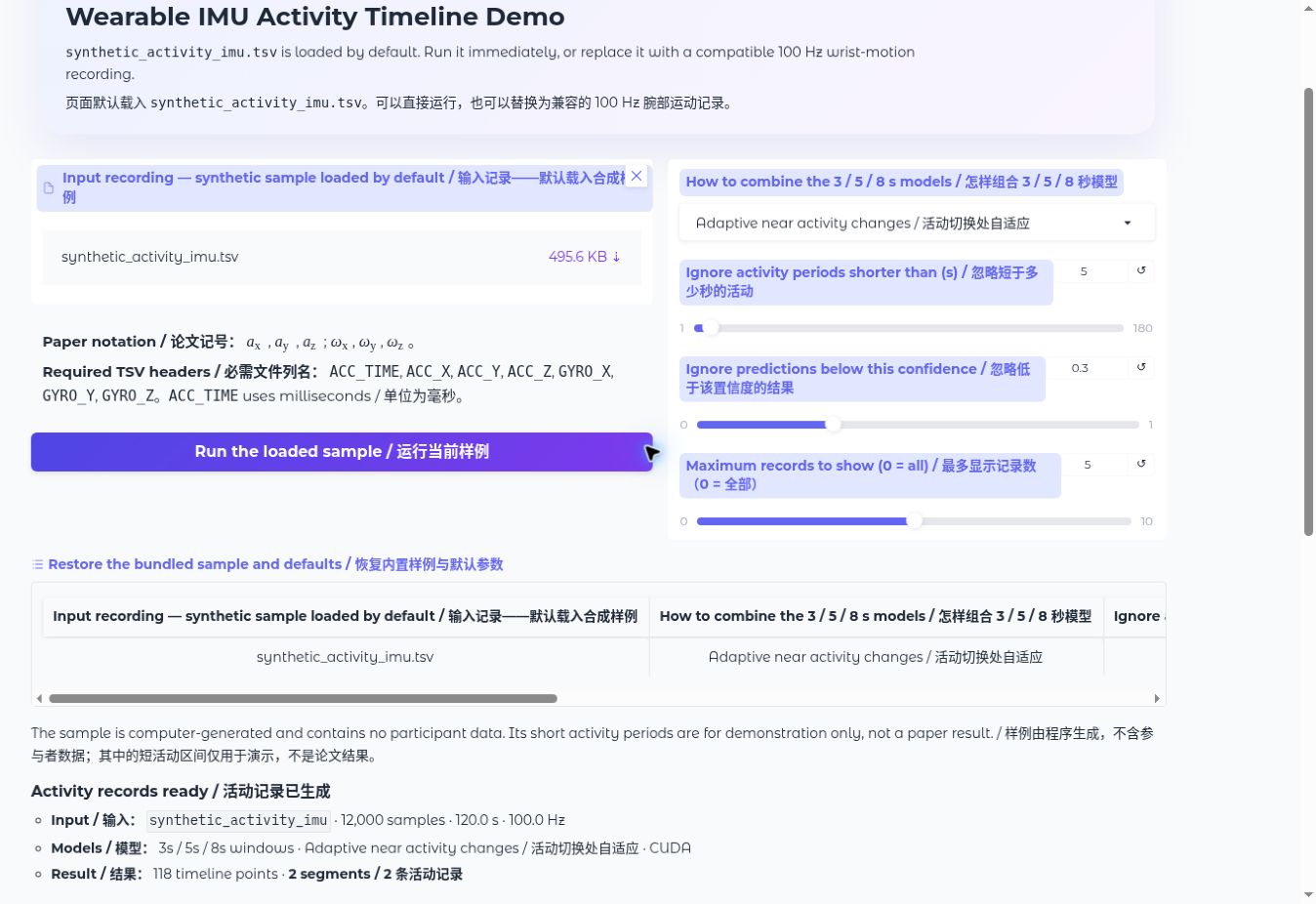 Run locally in this browser →
Browser demo
Signals, probabilities, timeline, and records in one view
Run the public 3-, 5-, and 8-second ONNX models with the bundled synthetic recording or a compatible wrist-IMU file. Samples stay on the visitor's device.
- Six-channel signal plots
- Decoded activity timeline
- Record table and CSV export
Reproduce and inspect
GitHub
Browse the package, experiments, Android app, issues, and release history.
WeightsModels
Download verified PyTorch and ONNX assets from Hugging Face.
CodeQuickstart
Verify the public package and run authorized-data inference.
On-device demoAndroid APK
Download the app and a synthetic sample for offline on-device inference.
Participant recordings are not distributed on GitHub. The reproduction guide separates public verification from workflows that require authorized data.