Results
The primary analysis evaluates complete activity records on an independent external test set.
Evaluation protocol
Predictions are matched one-to-one with same-class reference segments at IoU > 0.5. This record-level protocol penalizes missed and false activities, fragmentation, merging, wrong classes, and shifted boundaries.
| Data role | Recordings | Use |
|---|---|---|
| Training | 80 | Model fitting and training-stage checkpoint selection |
| Development / calibration | 20 | Temporal-policy calibration and diagnostics |
| Independent external test | 37 | One final evaluation after all choices were frozen |
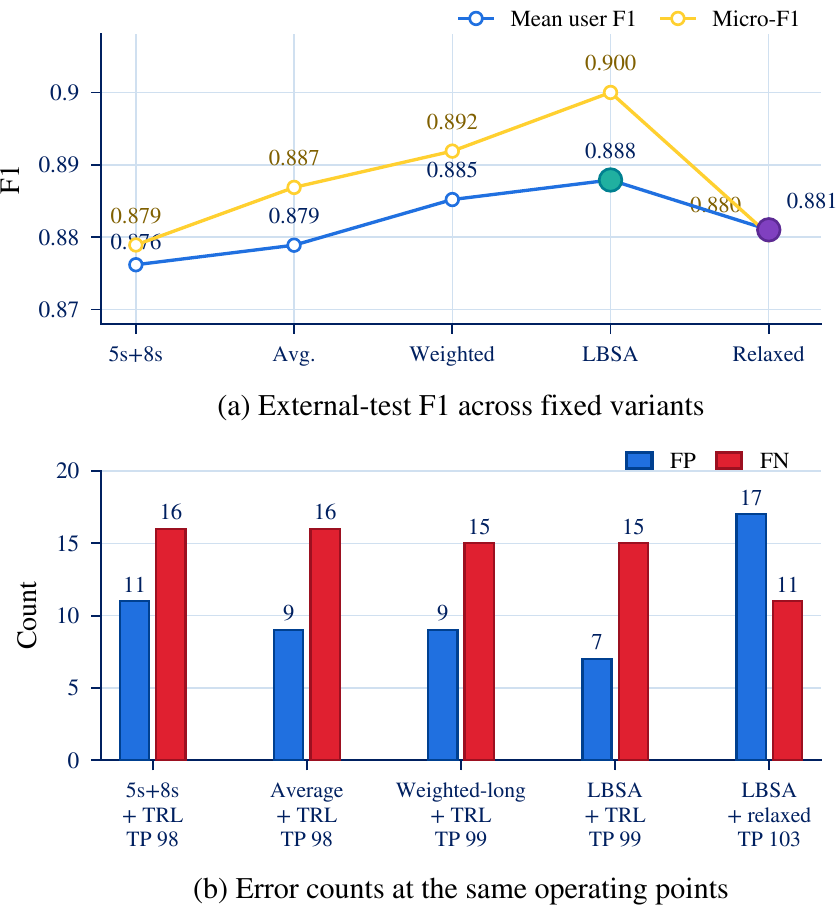
External labels were not used to select checkpoints, fusion rules, TRL parameters, or reported variants. Mean-user F1 weights each user equally; micro-F1 pools TP, FP, and FN over the complete set.
External test
| Fixed variant | Mean-user F1 | 95% CI | Micro-F1 | TP / FP / FN |
|---|---|---|---|---|
| 5 s + 8 s + TRL | 0.88 | 0.80–0.94 | 0.88 | 98 / 11 / 16 |
| Three-model average + TRL | 0.88 | 0.80–0.94 | 0.89 | 98 / 9 / 16 |
| Three-model weighted + TRL | 0.89 | 0.81–0.94 | 0.89 | 99 / 9 / 15 |
| LBSA + relaxed Top-K | 0.88 | 0.80–0.95 | 0.88 | 103 / 17 / 11 |
| LBSA + TRL | 0.89 | 0.82–0.94 | 0.90 | 99 / 7 / 15 |
By activity
| Activity | Reference segments | TP / FP / FN | Precision | Recall | F1 | Matched IoU |
|---|---|---|---|---|---|---|
| Badminton | 32 | 26 / 3 / 6 | 0.90 | 0.81 | 0.85 | 0.87 |
| Rope skipping | 20 | 19 / 0 / 1 | 1.00 | 0.95 | 0.97 | 0.84 |
| Dumbbell fly | 20 | 19 / 1 / 1 | 0.95 | 0.95 | 0.95 | 0.78 |
| Running | 20 | 18 / 1 / 2 | 0.95 | 0.90 | 0.92 | 0.82 |
| Table tennis | 22 | 17 / 2 / 5 | 0.90 | 0.77 | 0.83 | 0.86 |
Rope skipping has the highest F1. Table tennis has the lowest recall, indicating that weak or ambiguous evidence still causes missed records.
Representative cases
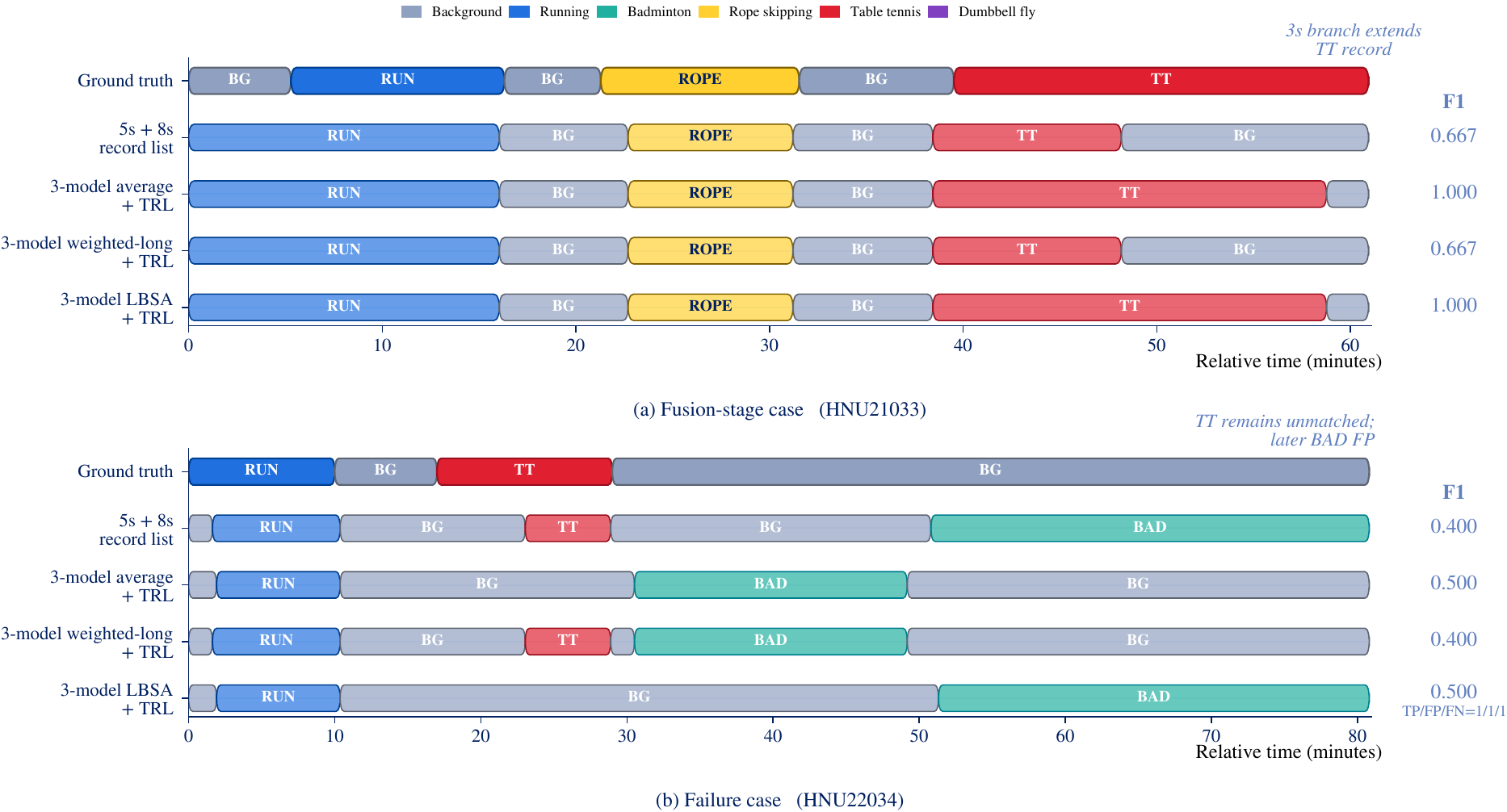
Scale arbitration improves a boundary in the successful case. The failure case retains a miss and a false alarm where posterior evidence is weak; TRL cannot reconstruct activity evidence that the classifiers never provide.
Limitations
Evaluated scope
- Results measure segment-record quality, not clinical, coaching, or safety value.
- Evidence covers five activities under the studied device, placement, and protocol.
- New devices, placements, users, activities, and deployment conditions require new validation.
- Dense sessions and adjacent same-class events remain difficult.
Development diagnostics, public-dataset portability checks, and Android implementation evidence are reported separately in Supplementary analyses. Reproduction commands and asset boundaries are collected on the Reproduce page.